
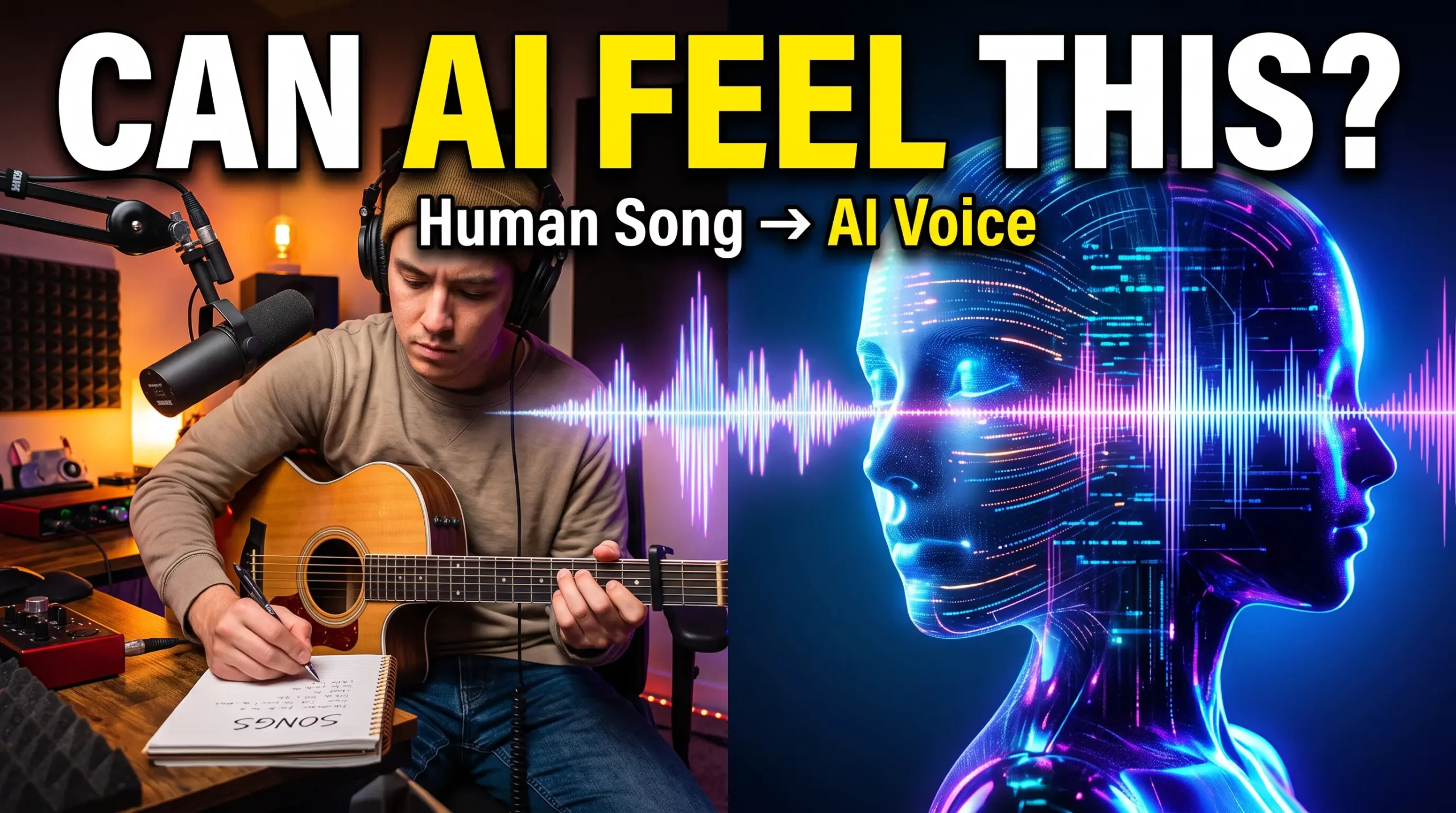
Every song starts somewhere.
Sometimes it begins with a melody played on an instrument. Sometimes it starts with a lyric idea written down in a notebook. Sometimes it comes from a moment, a memory, or a feeling that needs a place to exist.
“Beautiful Day Beautiful Life” began as a human-written song — created from my own songwriting journey, experiences, and creative ideas. But this time, I wanted to explore a different question:
Can AI capture the feeling and emotion behind a song that was written by a human?
For this experiment, I took my original song and explored what happens when it receives a completely different type of performance: an AI-generated vocal interpretation.
This is not about replacing musicians or claiming that technology creates the same experience as a human performer. Instead, it is about exploring a new creative tool and asking how a song can change when it is placed into a different voice, style, and interpretation.
The Song Behind the Experiment
Every song has a story before anyone hears the final recording.
The lyrics, melody, arrangement, and production choices all come from somewhere. A songwriter might spend years developing their craft, learning instruments, experimenting with sounds, and collecting the experiences that eventually become songs.
That human creative process is the foundation of “Beautiful Day Beautiful Life.”
The AI performance is not the origin of the song. It is another interpretation of something that already existed.
Just like different singers can bring different emotions and personalities to the same composition, AI introduces another way of hearing the music.
Human-Written. AI-Performed.
One of the biggest conversations happening in music today is the relationship between artificial intelligence and creativity.
Can technology create emotion? Can a machine understand the meaning behind lyrics? Does a performance need a human behind it to feel authentic?
These are questions that do not have simple answers.
Music has always evolved alongside technology. Recording equipment, synthesizers, drum machines, digital audio workstations, and virtual instruments all changed the way artists create. AI is another tool entering that creative landscape.
The important question may not be whether AI replaces human creativity, but how humans choose to use these new tools.
The Song Stories Journey
The goal of the Song Stories series is to explore the journey behind original songs — from the first idea to demos, productions, and new interpretations.
A song is more than just the final audio file. It is the story behind the lyrics, the decisions made during production, and the emotions that inspired it.
“Beautiful Day Beautiful Life” is another chapter in that journey.
By comparing different versions and interpretations, we can discover something interesting: sometimes changing the performance can reveal new parts of a song that were always there.
The Question for Listeners
At the end of the day, music is personal.
One listener may connect deeply with an AI performance. Another may feel that human imperfections and personal experiences are what make a performance meaningful.
Both perspectives are part of the conversation.
So the question remains:
Can AI capture the emotion of a human-written song?
Listen to “Beautiful Day Beautiful Life” and decide for yourself.
The technology may be new, but the heart of the experiment remains the same: exploring how songs connect with people.

Comments
19 responses to “Can AI Capture the Feeling of a Human-Written Song? Exploring Beautiful Day Beautiful Life”
As a passionate music lover, this experiment really made me stop and think. Music has always been about emotion for me; the way a singer’s voice cracks, or how a subtle change in tone can carry so much feeling. Seeing your song interpreted through AI vocals is fascinating because it raises the question of whether technology can truly capture that human depth or if it simply offers a new lens to experience the same piece.
I love how you framed AI not as a replacement but as another creative tool, much like synthesizers or drum machines once were. It makes me wonder: do you feel AI interpretations can sometimes highlight hidden layers in a song that even the original artist might not have noticed?
Yeah, I’m not sure exactly what you mean by “highlight hidden layers,” but I do find the whole thing insanely impressive. For me, AI has also become a really interesting learning tool. I’ve learned a lot about my own songwriting and production by hearing the same song interpreted in completely different genres.
Sometimes it feels like I’m hearing my own song for the first time. When you’ve been sitting there producing a song and listening to it 100,000 times, you can get so used to it that it’s hard to hear it objectively anymore. Then you hear it in a completely different style, and suddenly you’re hearing the songwriting, arrangement, melody, or even production choices differently.
So yeah, beyond just being an interesting experiment, I think AI can actually be a pretty powerful tool for learning more about your own music.
This is such an interesting topic. I think AI can do a great job creating music, but there’s something different about a song that comes from a real person’s memories, emotions, and experiences. Sometimes the little imperfections are what make a song feel genuine. I’m curious to see how AI music will continue to develop while still keeping that human feeling.
Hello, Greg! Treating the AI vocal as an interpretation rather than the origin of “Beautiful Day Beautiful Life” hopefully keeps the songwriter’s intent at the center of the experiment. As a performer, I find that emotion lives not only in pitch and phrasing, but also in the tiny timing choices, breaths, and imperfect moments that make one version feel personal.
AI can clearly evoke an emotional response, but listeners may experience its impact differently than with human-made music, so hearing alternate versions of the same song is a useful comparison. I would be curious whether a live human vocal version sits alongside the AI interpretation, because that would make the contrast in delivery, production, and connection even more revealing.
I haven’t tried that yet. The original vocalist I hired for this song didn’t quite sing it the way I wanted — the same kind of inflections and phrasing issues have actually happened to me quite a few times when hiring vocalists online. I also don’t think her voice would really work over the AI version of the song because of timing and other issues, since she wasn’t singing to that particular track.
But overall, I’m pretty happy with what I’m getting from the AI versions. One thing I really like is being able to hear my songs performed differently and explore what other things I might want to do with them before deciding how I want to have them professionally produced — or whether I even want to take them that far. It’s become a pretty interesting part of the songwriting process for me.
I listened to this song before, and I must say that I prefer the live male voice you had. However this is also a great rendition using AI. The only problem with AI is that sometimes it is too perfect, and it lacks the emotion that a real person would have. So at least we know that there are some things that AI will never be able to replace.
Thanks, Michel, for the comment.
This is a really interesting topic, especially for someone who enjoys music and music production. I agree that AI can give a song a completely different interpretation, but I think the human experience behind the original songwriting is something special. A melody or lyric may come from memories, struggles, happiness, or personal experiences that AI itself has never lived through. At the same time, I like the idea of using AI as a creative tool to hear a song from a different perspective. Do you think AI performances will eventually become emotionally indistinguishable from human performances, or will listeners always be able to recognize the difference?
Thanks for the comment. I think they already have.
This was interesting and asks relevant questions. I am in the community theater community in my area. Many of my theater friends are totally against AI in art, saying it destroys creativity.
I like the was you are framing this and asking the questions as an artist. Recently, I was listening on YouTube to a collection of 70s songs. I heard familiar artists in this collection. Then came a song that I didn’t recognize, but it caught my attention. The words were compelling and heart felt. The orchestration was well done. In the chat, listeners had been asking who the singer was, but the person who had put the collection together was not answering their questions. I tried Google and ChatGPT to find the answer to who wrote and performed the song, but i came up empty. Then I saw there was a disclosure that the collection contained AI content. I knew the video was AI, but I didn’t think the music would also be AI.
To answer your question, can AI capture the emotion in a song? In this case, I think it definitely did. That song had me captivated for quite some time.
Yeah, exactly! One of the things that really caught my interest in AI music was hearing old songs reproduced in completely different genres. That got me thinking about what I could do with my own songs and how many different directions they could go in. It’s pretty fascinating!
Hi Greg,
Your article made me think about the difference between creating emotion and delivering it. The lyrics, melody, and meaning came from your own life and creative choices. The AI voice may not feel those emotions, but it can still help carry them to the listener.
I see it a little like an actor reading someone else’s script. The actor did not live the writer’s story, but the performance can still move people. AI may work in a similar way, although the human songwriter remains the source of the song’s heart.
When an AI version takes your song in a direction you did not expect, do you consider that only a new performance, or does the AI become part of the songwriting process too?
I think that’s a good distinction. I wouldn’t say AI becomes part of the songwriting process, because the songwriting—the lyrics, melody, and underlying idea—is still mine. But it can definitely become part of the arrangement and production process.
Sometimes AI makes an arrangement choice I may not have thought of, and that can influence how I hear the song going forward. So I see it less as AI helping me write the song and more as another tool that can help me discover what the song could become.
Hey, Greg,
Finding new dimensions in a composition through different performances is what keeps music exciting. Whether those interpretations come from another vocalist in a studio or an algorithmic generation, they simply serve as mirrors reflecting back the emotional weight we already baked into the original chords and words.
Exploring how technology intersects with human storytelling is such a fascinating journey, Greg. Thanks for sharing this thought-provoking experiment!
John
Thanks, John! I really appreciate the thoughtful comment. That’s exactly what makes this whole experiment so interesting to me—the intersection of human songwriting, technology, and all the different ways a song can be interpreted.
I found this really thought-provoking because it doesn’t frame AI as replacing the songwriter. Instead, it treats the AI vocal as another interpretation of an already human-created song. The comparison to how different singers can bring different emotions to the same composition made the experiment easier to understand.
I would have liked a little more discussion of what changed emotionally in the AI version. Did it make the song feel happier, more polished, less intimate, or surprisingly different? That would make the experiment even more interesting.
After hearing the AI performance yourself, did it reveal anything in Beautiful Day Beautiful Life that you hadn’t noticed or intended when you originally wrote it?
Thanks for the thoughtful comment! Yes, the AI version actually did reveal some things I hadn’t really noticed in the original. Another interesting thing is that you can test your songs in completely different genres and see where they work best. Some songs work surprisingly well across many genres, while others really only seem to work in a few. That’s been a fascinating part of the experiment.
You brought up such a fascinating question, because heart and human connection are things technology just can’t manufacture. AI might be able to imitate a sound, but it takes genuine life experience to put real feeling into a track. I love that your post encourages us to slow down and reflect on what makes music so deeply personal!
Thanks for the comment! I completely agree. AI can help recreate the sound, but the experiences and emotions behind the song still come from the person who wrote it. That human connection is what makes the whole experiment so interesting.