
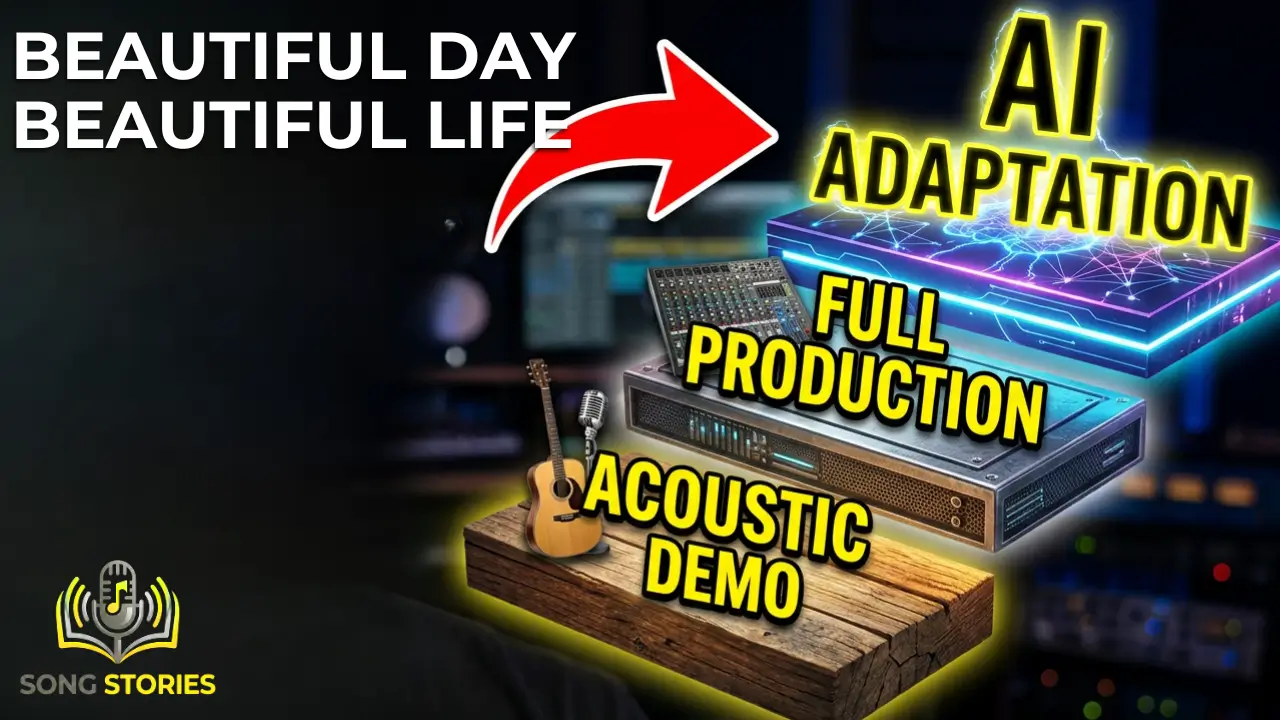
Watch the video below to hear how “Beautiful Day, Beautiful Life” evolved from an acoustic guitar idea into a production demo and several AI adaptations.
Song Stories Episode 1
About This Episode
Welcome to the first episode of Song Stories, a series where I revisit original songs I’ve written over the years, share different parts of their creative journey, and explore how they’ve evolved over time.
This episode follows the evolution of my original song “Beautiful Day, Beautiful Life.” Rather than focusing on a finished release, this episode documents several stages of the song—from its beginnings on acoustic guitar, to a full production demo with a vocalist, and finally to AI-generated interpretations created from that original production.
Every version tells the same musical story in a different way.
How “Beautiful Day, Beautiful Life” Began
Like many of my songs, this one started with nothing more than an acoustic guitar and a simple work tape.
I wrote the song in 2020, capturing the initial melody and lyrics before expanding it into a full production.
Although the original acoustic recording isn’t featured in full during this episode, it became the foundation for everything that followed.
From Song Idea to Production Demo
Once the basic structure was in place, I began producing the song.
Since I’m not a vocalist, I hired vocalist Liel Bar-Z to perform the lead vocal on the production demo.
That version became the reference point for future arrangements and eventually served as the source material for the AI adaptations featured in this episode.
During production I also experimented with alternate mixes and arrangements, exploring different ways the same vocal performance could change the feel of the song.
Exploring AI Adaptations
One of the most interesting parts of this episode is hearing how AI interpreted my original production demo.
Rather than writing a new song, the AI generated new performances based on material from my existing production.
Listening to those versions reminded me that a single song can take on a completely different personality depending on the arrangement, instrumentation, and performance.
For me, AI isn’t replacing the songwriting process—it’s another creative tool that lets me hear my own songs from a new perspective.
The Lyrics Are Open to Interpretation
One thing I intentionally avoid doing is explaining exactly what the lyrics mean.
I’ve always believed songs become more meaningful when listeners bring their own experiences to them.
If you’ve watched the video, I’d love to hear your interpretation.
Which lyric stood out to you the most, and what do you think it means?
The complete lyrics are available in the pinned YouTube comment for discussion.
Does This Song Have a Verse or a Chorus?
One of the fun conversations surrounding this song is its structure.
Some listeners might hear a traditional chorus.
Others may argue the song doesn’t really have one at all.
The arrangement also raises interesting questions about whether the song follows a conventional verse-and-chorus format or something a little different.
I’ll explore that topic in a future Song Stories episode.
Which Version Do You Prefer?
This episode features several versions of the same song:
- Original songwriting idea
- Production demo
- AI adaptation
- Alternate production arrangement
Every version reveals something different about the song.
I’d love to know:
- Which version connected with you the most?
- Which arrangement would you choose?
- Would you release the production demo, the AI version, or something entirely new?
About Song Stories
Song Stories is an ongoing series documenting the evolution of my original songs.
Some episodes focus on songwriting.
Others explore production, alternate arrangements, lyrics, AI adaptations, creative decisions, or the recording process.
Every episode tells another chapter in the life of a song.
If you’d like to follow future episodes, subscribe on YouTube and check back here for new additions to the series.

Comments
20 responses to “The Evolution of “Beautiful Day, Beautiful Life” — From Acoustic Demo to AI Adaptation”
Hello Greg, I really like the lyrics. They have a nice feeling to them, and I enjoyed seeing how the song evolved from the acoustic demo into the AI adaptation. It’s very interesting to see what AI can add to an original song while still keeping the meaning behind the lyrics. I’ll definitely follow your channel for more because this is really interesting. What inspired you to write the lyrics in the first place?
With this one, I think the inspiration was more subconscious than anything. I just sat down with the guitar one day and started playing those chords, and “it’s a beautiful day in a beautiful life” was the first thing that popped into my head — with the exact same melody you hear in the song. Sometimes that happens, and it’s a strange thing when it does because you don’t really know where it came from.
The lyrics that follow came pretty naturally too. The idea was basically, “it’s a beautiful day in a beautiful life… but for how long?” That question kind of became the starting point for the rest of the song.
So honestly, there wasn’t some big story or specific event behind this one. It was really just a spur-of-the-moment songwriting session where the melody and the first line showed up, and I followed them from there. Those are some of my favorite songs to write because you almost feel like you’re discovering the song rather than creating it.
This song just gets better and better. I love the last Alternate production arrangement the best and it doesn’t even sound as if AI was involved in any way.
The words are beautiful and it is only enhanced with all the new versions you do, although I love Liel Bar-Z’s voice.
It is truly amazing what AI can do to make everything we do just that bit better.
Thanks for taking the time to listen and thanks for the wonderful comment. And yes, I love Liel’s voice as well.
I really enjoyed watching the evolution of Beautiful Day, Beautiful Life. As a fellow musician and songwriter, it’s inspiring to see how you’ve documented the journey from a simple acoustic idea to a full demo and even AI interpretations. I’ve been thinking about starting a YouTube channel to share my own compositions, and seeing how you present different versions of the same song makes me realize how engaging it can be to let listeners in on the creative process rather than just the polished final track.
I especially love how you highlight that each version tells the same story in a different way; it makes me wonder how my own songs might resonate if I shared their early drafts alongside more produced versions. Do you find that listeners connect more deeply when they can see the song’s journey rather than just the finished product?
I’m really not sure yet. I just put this up not too long ago, so I haven’t gotten enough feedback to know whether people are connecting with the songs more because I’m showing the journey.
Personally, though, I’ve always enjoyed hearing the stories and background behind songs I like from artists I like. So I imagine there are probably people who enjoy getting a look at how a song develops rather than just hearing the finished version.
Thanks for the comment and the question!
It’s probably just me, being an old-school folk music fan from waaaay back, but I enjoyed the initial rendition best. I like the simple cleanness of it without the heavy production elements. KBCO has a segment called “Studio C” where they have artists come in and do stripped-down acoustic versions of their most popular tunes, and I just love that style. It sounds more connected, I can hear the raw emotion more clearly.
Thanks for your input.
I find this use of AI in music particularly interesting because you’re starting with something you actually wrote and produced and then using AI to explore what else that same song could become. That feels very different from simply asking AI to generate a song from scratch. The original melody, lyrics, and creative decisions are still yours, while AI becomes another way of experimenting with arrangements and performances.
It’s interesting that you tend not to explain the lyrics. I think other composers do that as well. I think Cohen’s song “Hallelujah” is very confusing. I don’t think he’s ever explained it, so people have various ides of its meaning, including thinking it’s a worship song.
I’ve been watching AI change rapidly in other creative areas, and I think we’re only beginning to figure out where it fits into the process. I can imagine hearing an AI interpretation of your own song might even give you ideas you wouldn’t have considered when you originally wrote it.
Have any of the AI adaptations surprised you enough that you went back and changed something in one of your own arrangements because of what the AI did?
Yeah, definitely! One example is a song where I had a guitar part that only came in toward the end as kind of a buildup. One of the AI versions took that guitar riff and sprinkled it throughout different sections of the song, which I thought was really interesting.
I haven’t actually added it to my original arrangement yet because I haven’t gotten back to working on that song, but there are definitely little surprises like that where AI gives you an idea you might not have thought of yourself.
This is such a cool way to revisit an older song. I can imagine hearing AI take the same melody in a completely different direction could make you notice things you never heard in the original.
Have any of the AI versions made you think, “I actually wish I’d produced it this way the first time”?
Absolutely. In a way, it’s starting to become part of my production process. Professional mixers and producers often use reference tracks to calibrate their ears to the sound of a professional recording—things like EQ balance, overall sound, and production techniques. But when you can use your own song as a reference track and have AI create a completely different production of it, that’s pretty fascinating.
There are definitely parts where I think, “Wow, I really like what they did there,” even though I still might not be able to reproduce it exactly myself. I can take the things I like, figure out what works and what doesn’t, and actually use that to become a better producer and mixer. I’ve learned a lot about my own songs and productions just by hearing them from different perspectives, with different arrangements and mixes. In that sense, I find AI in music to be a really interesting learning tool.
Hi Greg,
I like the idea that a song can have a journey instead of only one finished version. Keeping the acoustic idea, production demo, alternate arrangement, and AI adaptations lets people see how each creative choice changes the song’s personality.
At the same time, AI can create almost endless versions. That sounds exciting, but I imagine it could also make it harder to decide when a song is truly finished.
How do you decide that one version is ready to release instead of trying one more arrangement or AI adaptation? Do you set a goal before you begin, or do you simply know when a version feels right?
The Song Stories format seems like a good way to preserve the whole journey, even when only one version becomes the final release.
Once the song itself is complete—the lyrics and melody—there’s really no end to the number of arrangements or versions that can be created. To me, the most important thing is the song first. After that, where it goes can almost have a life of its own.
You could take a song like “Yesterday” by The Beatles and there are probably thousands of different cover versions of it. They can all sound completely different, but they’re still the same song. Anyone can take that song and interpret it in their own way.
So I don’t necessarily think about one version being the definitive version. The song is the foundation, and everything that comes after that is another way of bringing it to life.
Greg, I like the way you present the song as a creative journey rather than simply a finished product. The progression from an acoustic idea to a production demo and then to AI adaptations shows how one piece of songwriting can take on different identities through arrangement and performance. This is the world we live in. Technology.
I also find your view of AI interesting. Rather than treating it as a replacement for the songwriter, you use it as a way to hear your own work differently. That raises a good question: when an AI adaptation changes the arrangement, performance, and personality of an original song so significantly, where do you draw the line between an adaptation of the original work and a genuinely new creative interpretation?
John
I see it more as a cover version of the song. There really isn’t a clear line, because other artists can take the same song and perform it in completely different genres, with completely different arrangements and personalities, and it’s still the same song.
For me, the core of the song is the lyrics and melody. As long as those remain, I still consider it the same song, even if the arrangement, instrumentation, genre, and performance change dramatically. So I don’t think there necessarily has to be a line between an adaptation and a new creative interpretation.
I really enjoyed how this episode traces the complete creative journey of “Beautiful Day, Beautiful Life,” from a simple acoustic guitar idea to a production demo and then to AI-generated interpretations. From a communication perspective, I especially appreciate the decision to leave the lyrics open to interpretation, it invites listeners to connect the song with their own experiences rather than prescribing a single meaning. The exploration of how arrangement and performance can change the personality of the same song is also fascinating. It’s a great example of how creative tools can expand an artist’s perspective while keeping the original songwriting at the heart of the process.
Thank you! That’s exactly what I find so interesting about this whole process. The song itself stays at the center of it, but once you start changing the arrangement, instrumentation, or performance, you can almost hear a completely different personality emerge from the same underlying songwriting.
And I agree about leaving the lyrics open to interpretation. I think sometimes explaining exactly what a song means can actually take away from the listener’s experience. I’d much rather let people bring their own story to it.
What a fascinating look at the creative journey—it’s so neat to see how a piece of music can transform from a simple acoustic core into something entirely new with AI. As a mom, watching tech open up fresh ways to bring ideas to life like this just amazes me. Thank you for sharing such an insightful look behind the curtain of your creative process!
Thanks so much! That’s one of the things I find most interesting about this process—seeing how the same song can take on a completely different life when you change the arrangement, genre, or production.