What if you could take a guitar track in your DAW and turn it into a convincing bass sound without actually owning or recording a bass guitar?
That is exactly what Box of Bass from Box of Rules can do with its built-in Guitar Mode. Box of Bass is primarily designed as a bass rig plugin, but Guitar Mode adds a surprisingly useful trick: it pitches the entire signal chain down an octave, allowing a standard electric guitar to produce a bass-style sound.
And the best part is that Box of Bass is free.
Related Posts: Ample Bass P Lite 4 Review: One of the Best Free Bass Plugins Just Got Better
How to Turn Guitar Into Bass
The process is extremely simple.
Start with a guitar track recorded directly into your DAW. In my example, I am playing an actual guitar through a direct input, with no bass guitar involved.
Then load Box of Bass and enable Guitar Mode.
The plugin automatically shifts the entire signal chain down an octave. Instead of hearing the original guitar at its normal pitch, you get a lower bass-like sound that can then be shaped using the different processing layers inside Box of Bass.
This makes the plugin particularly interesting for songwriters and producers who have guitar tracks but need a bass part for a demo, production, or arrangement.
Box of Bass Is More Than an Octave Effect
The Guitar Mode feature is what initially caught my attention, but Box of Bass is much more than a simple octave-down effect.
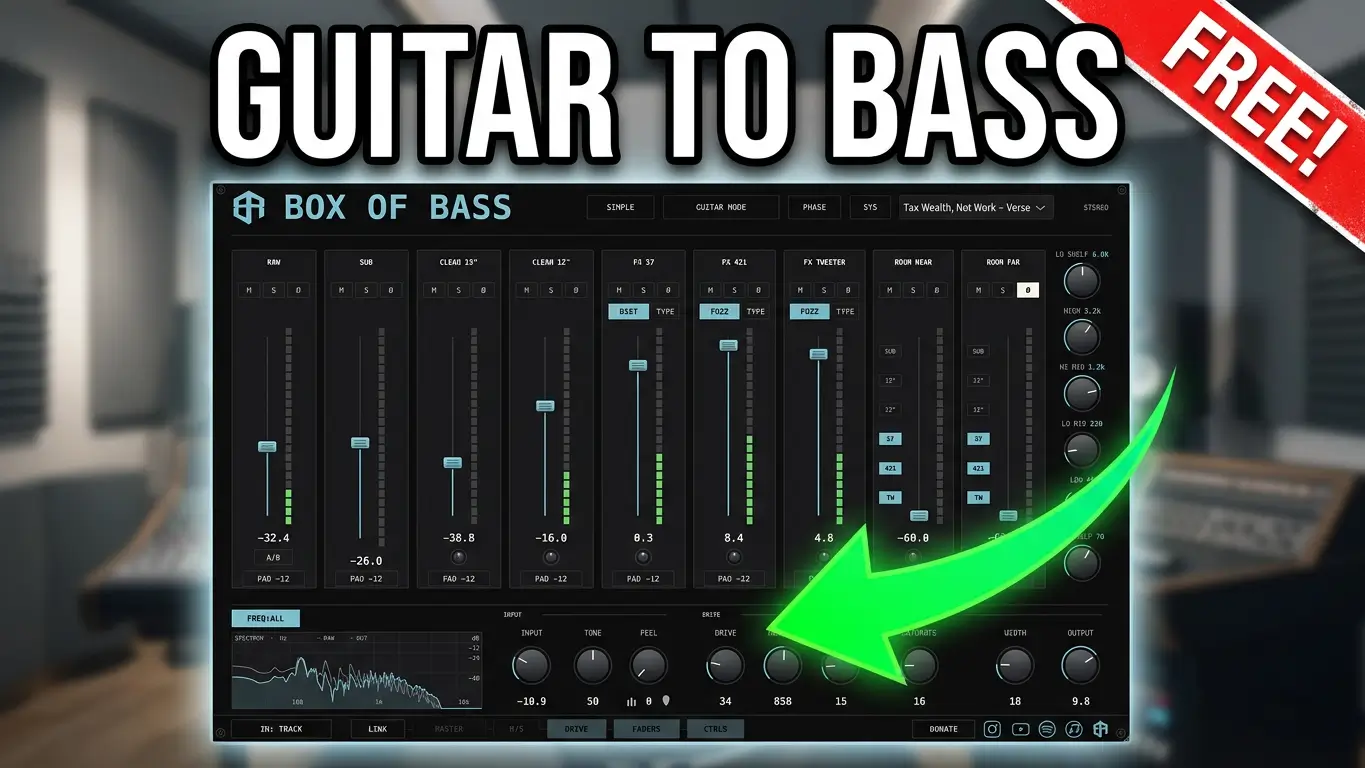
The plugin takes the incoming signal and splits it into multiple processing paths. These include the raw signal, true sub, clean 15-inch cabinet, clean 12-inch cabinet, FX 57, FX 421, tweeter effects, near room, and far room.
That means you can build a much more complete bass sound than you would typically get from simply putting an octave pedal or pitch-shifting plugin on a guitar track.
You can blend different layers together depending on the sound you want.
Add Fuzz, Drive and Other Bass Processing
Box of Bass also includes additional processing for shaping the sound.
The higher-frequency channels can be used for effects such as fuzz and other driven sounds, while the plugin also provides controls for saturation, drive, release, sustain, phase, and master EQ.
This gives you the ability to keep the low end relatively clean while adding distortion and character to the higher-frequency parts of the sound.
You can also mute individual layers to hear exactly what each part contributes.
For example, you can isolate the sub layer, bring in one of the clean cabinets, add a driven microphone, or blend in room microphones to give the sound additional space.
A Bass Rig Inside One Plugin
Box of Bass includes two clean cabinets, a true sub, three driven microphones, and two room microphones, giving you a surprisingly flexible bass-processing setup.
The plugin is designed primarily around DI bass guitar, but Guitar Mode makes it useful for guitar players as well.
If you have a guitar track that needs to become a bass part, this gives you another option without having to rerecord the performance on bass.
It can also be useful for songwriting when you have a guitar and an idea for a bass part but do not have a bass guitar available.
Is This the Best Free Guitar-to-Bass Plugin?
I would not necessarily call any single plugin the definitive best option for every situation, but Box of Bass is certainly an interesting free solution for turning guitar into bass.
The important thing is that the octave-down Guitar Mode is combined with an entire bass-processing chain. You are not simply lowering the pitch of the guitar and stopping there. You can shape the resulting sound using subs, cabinets, driven microphone layers, fuzz, saturation, EQ, and room processing.
For a free plugin, that makes Box of Bass worth experimenting with if you regularly work with guitar and need bass sounds.
You can start with a guitar DI track, enable Guitar Mode, and build your bass sound from there.
Box of Bass is available from Box of Rules, and Guitar Mode is one of the most interesting features to try if you want to turn guitar into bass without recording an actual bass guitar.