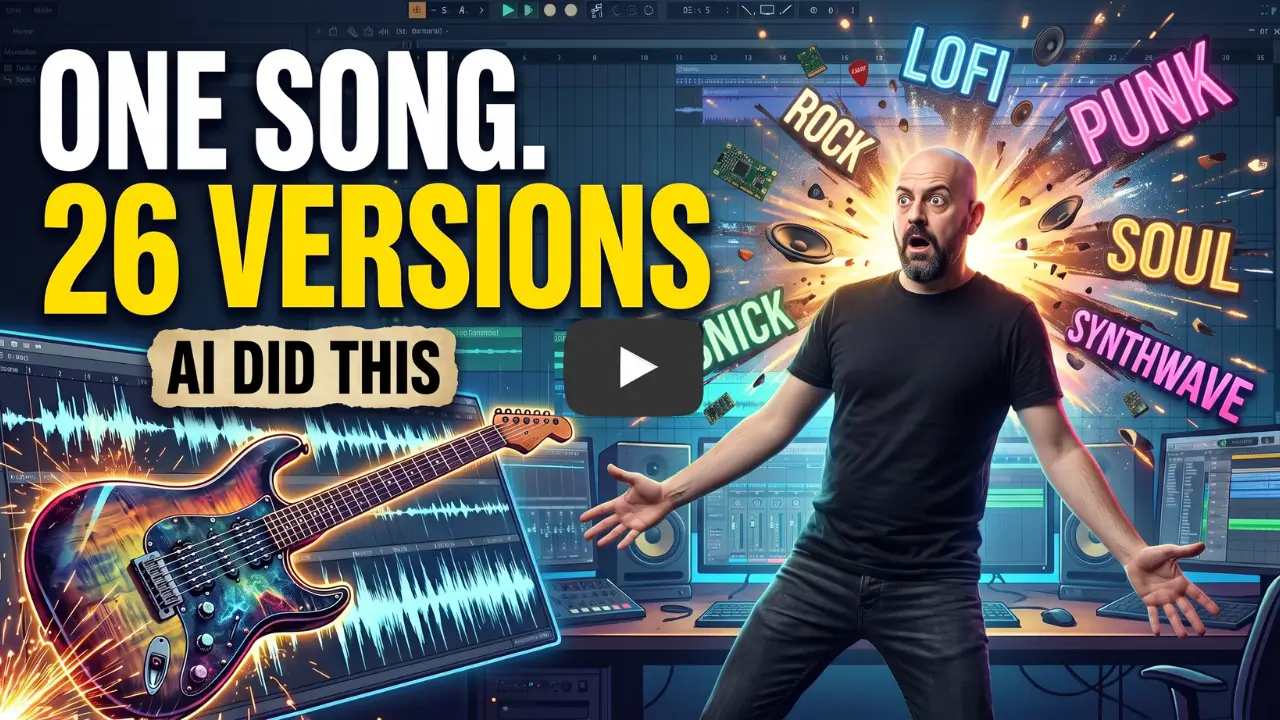
What happens when a song you wrote years ago gets completely reimagined in different musical styles?
That’s the question behind “No More,” the subject of Episode 2 of my Song Stories series. The song began in 2021 with a simple guitar riff and eventually developed into a complete production, a recording with a hired vocalist, and, years later, a collection of AI-assisted reinterpretations in genres ranging from LoFi and punk to synthwave, Motown, and 70s rock.
For me, the interesting part isn’t simply hearing what AI can do with a song. It’s hearing one piece of songwriting interpreted in ways I never originally imagined.
Related: Official Bootlegs 1: Days Like These
How “No More” Started
I originally wrote “No More” in 2021 while taking Ryan Tedder’s songwriting and production course.
One of the exercises was to start with a musical idea, create a production around it in a DAW, and then write the song on top of that production.
In my case, the starting point was a guitar riff.
That riff became the foundation for everything that followed.
Once I had the guitar part, I began experimenting with melodies. The guitar was already fairly busy, so I deliberately kept the vocal melody relatively short and simple.
The first words that came out were:
“No more.”
That phrase became the central hook of the song.
From there, I developed the verses, choruses, additional hooks, and eventually a bridge. Like many songwriting processes, the song wasn’t completely mapped out from the beginning. Some sections appeared naturally as I worked, while other sections were added later because the song needed something more.
At one point, I realized the song felt too short, so I added an extended section built around the idea of “no more.”
That became another important part of the arrangement.
From Songwriting Exercise to Full Production
After the songwriting was finished, I produced a complete demo of “No More” in Logic Pro.
I originally recorded a scratch vocal and eventually hired a vocalist to record the lead vocal and harmonies.
That original production demo has been available on YouTube for several years, so the song has already had a life beyond the original songwriting exercise.
But the song didn’t stop there.
Years later, I started experimenting with AI music and discovered that I could use the original songwriting as the foundation for completely different interpretations.
That opened up an entirely different creative direction.
What Happens When AI Reinterprets the Same Song?
One of the things I find most interesting about AI-assisted music is the ability to take an existing song and hear it through a completely different musical lens.
With “No More,” I experimented with several different styles, including:
- Glitch
- LoFi
- Punk
- Synthwave
- 1960s Motown
- 1970s rock
- Country
- Jazz
- Other experimental variations
These aren’t completely new songs. The underlying songwriting is still mine.
The lyrics, melodies, hooks, and original musical ideas provide the foundation. What changes is the arrangement, instrumentation, production style, and performance.
That distinction is important to me.
I’m not using AI to replace the songwriting process. I’m using it as another way to explore a song I already wrote.
The Guitar Riff Takes on a Life of Its Own
One of the coolest things about the different versions is hearing what happens to the original guitar riff.
Sometimes the AI interpretation changes the instrument playing the part, but the basic melodic idea remains recognizable.
Other versions embellish the riff, alter individual notes, or build additional musical ideas around it.
That makes the process surprisingly similar to hearing another musician interpret one of your songs.
A different artist might take your original idea and change the instrumentation, rhythm, vocal delivery, or arrangement.
AI can create a similar experience—except you can explore a much larger number of possibilities very quickly.
And sometimes those unexpected changes are the most interesting part.
Hearing Your Own Song Differently
There’s another benefit I didn’t really anticipate when I started doing this.
As a songwriter and producer, you can hear a song so many times that you eventually become tired of it.
You’ve listened to the demo while writing it.
You’ve listened to it while recording vocals.
You’ve listened to it while editing.
You’ve listened to it while mixing.
You’ve listened to it while trying different arrangements.
Eventually, it’s easy to lose some of the excitement you had when you first wrote it.
AI reinterpretations can break that cycle.
When I hear an AI version of “No More” in a style I wasn’t expecting, I’m hearing the songwriting from a completely different perspective.
It’s almost like hearing another artist cover the song.
And because I didn’t make every creative decision in that new arrangement, there can be moments where I’m genuinely surprised by what I’m hearing.
That’s what makes the process interesting to me.
AI as a Songwriting and Production Learning Tool
There’s also a practical side to this.
Experimenting with different versions can reveal new possibilities for the original song.
For example, hearing “No More” as a punk track makes me think differently about the rhythm and energy of the song. A synthwave version emphasizes different aspects of the arrangement. A Motown-style interpretation highlights the groove and vocal phrasing in a completely different way.
These experiments can suggest ideas that could potentially be brought back into a future human-produced version.
In that sense, AI can function as a creative exploration and production tool.
You can use it to ask questions such as:
- What would this song sound like in another genre?
- What happens if the arrangement becomes much simpler?
- What happens if the song becomes more aggressive?
- Which parts of the original melody survive a major stylistic change?
- Could a different arrangement reveal something interesting about the songwriting?
- Is there an idea in an AI reinterpretation worth incorporating into a future production?
The answers aren’t always useful.
Sometimes an AI version simply sounds strange.
Sometimes it changes lyrics or musical details in ways I don’t like.
And sometimes it produces something unexpectedly cool.
That’s part of the experiment.
The Original Song Still Matters
One thing I don’t want to lose in all of these experiments is the original song.
The AI versions are adaptations and reinterpretations of an existing piece of songwriting.
The original “No More” began with a guitar riff, developed through songwriting and production in Logic Pro, and eventually became a recording with a human vocalist.
The AI versions are another chapter in that song’s evolution.
That’s one of the ideas behind the Song Stories series: a song doesn’t necessarily have to exist as only one finished recording.
There can be an original acoustic idea.
A production demo.
A recording with a vocalist.
An alternate arrangement.
An AI reinterpretation.
And potentially a completely new human-produced version years later.
Each version can tell you something different about the song.
The Songwriting Journey Continues
“No More” is a good example of why I started Song Stories in the first place.
I’m interested in what happens after the initial songwriting is finished.
A song can continue to evolve for years.
Sometimes the next version comes from a new production technique. Sometimes it’s a different arrangement. Sometimes it’s a new musician. And sometimes, in this case, it’s an AI reinterpretation that makes me hear something in the song that I hadn’t noticed before.
The goal isn’t necessarily to find one definitive version.
It’s about exploring the possibilities.
And “No More” turned out to have quite a few.
Watch Song Stories Episode 2: “No More”
In Episode 2 of Song Stories, I go inside the original creation of “No More,” show parts of the original Logic Pro production, discuss how the song developed, and play several of the AI reinterpretations.
You’ll hear the song transformed into styles including glitch, LoFi, punk, synthwave, Motown, and 70s rock.
Some versions are surprisingly close to the original ideas.
Others take the song somewhere completely unexpected.
And that’s exactly what makes the experiment so interesting.
Song: “No More”
Written by: Greg Kocis
Original production: Greg Kocis, featuring a hired vocalist
AI versions: AI-assisted reinterpretations based on my original songwriting and production material
Song Stories is an ongoing series exploring the origins, songwriting, production, and evolution of songs I’ve written over the years—including new arrangements and AI-assisted reinterpretations.
If you’re interested in songwriting, music production, Logic Pro, AI music, AI-assisted songwriting, music arrangement, and the creative process behind turning an idea into a finished song, follow along for more Song Stories episodes.
Related Post: The Evolution of “Beautiful Day, Beautiful Life” — From Acoustic Demo to AI Adaptation