
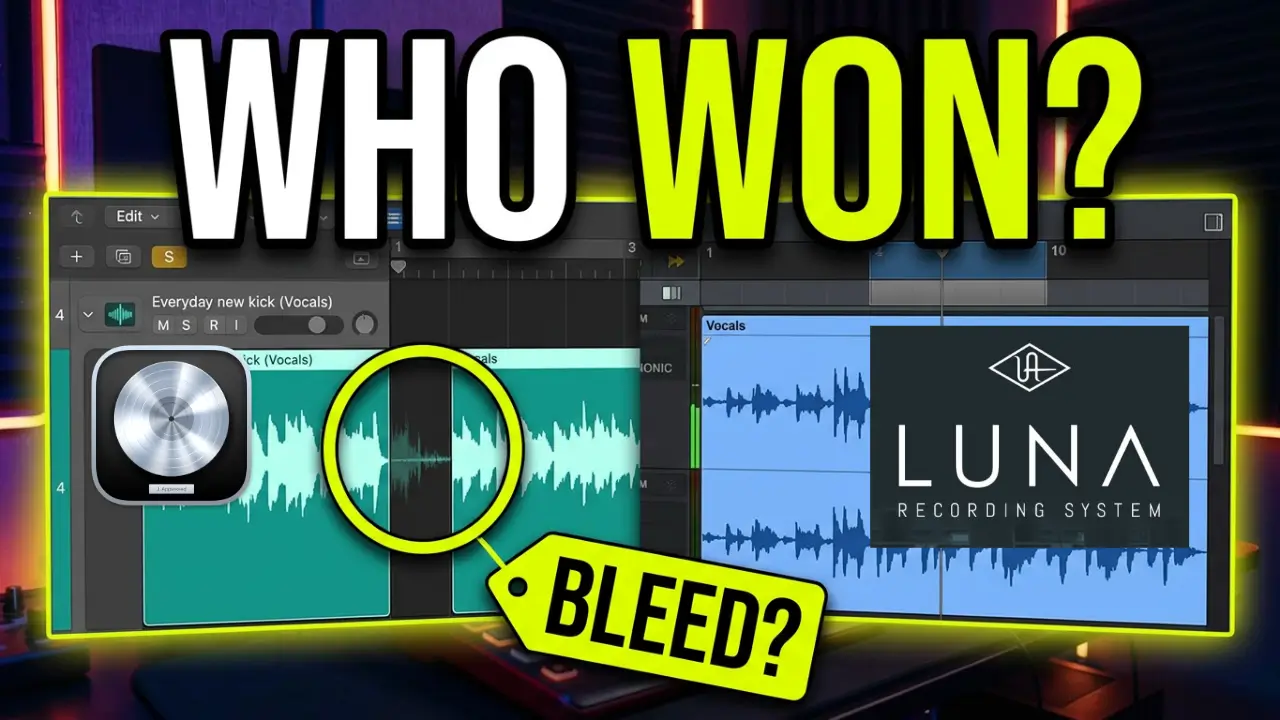
I tested Logic Pro’s Stem Splitter against Universal Audio’s Luna stem separation to see which DAW produces cleaner vocals, drums, bass, guitar, and brass when working with the same song. As a longtime Logic Pro user who has recently started experimenting with Luna, I wanted to hear how the two tools compare in a real-world test.
Watch the video below for the full comparison.
Logic Pro vs. Luna: The Stem Separation Test
For this test, I used one of my own songs and separated the audio using both Logic Pro and Luna. Luna offers four stems in its free version and six stems in the paid version. Since I was using the 30-day free trial, I tested the six-stem option.
I compared the individual results from each application, focusing on how cleanly the instruments were separated and whether unwanted artifacts appeared in the extracted audio.
Vocal Separation
I started with the vocals, paying particular attention to how each application handled the reverb tail. In this initial comparison, Logic Pro sounded a little cleaner, with less noticeable chopping of the reverb.
Drum Separation
The drum test revealed some crackling and what sounded like bleed-through in the Luna version. These artifacts made the separation sound less clean to my ears.
Bass and Guitar Separation
The bass comparison continued the same pattern, with Logic Pro sounding cleaner in this particular test. I then compared the guitar stems to see whether the difference was consistent across different instruments.
Brass and the Complete Stem Mix
I also tested another separated part that I believe was the brass stem. After listening to the individual instruments, I played the separated stems together to get a better sense of the overall results.
My Initial Verdict
Based on this song, I think Logic Pro produced clearer stems than Luna. The Luna results seemed to contain more noticeable artifacts, while the Logic Pro versions sounded cleaner overall.
This is only one test, though. Stem separation results can vary depending on the source recording, instrumentation, effects, and complexity of the mix. I would want to try more songs before making a broader judgment about which application consistently performs better.
I also have the original multitrack recording of this song, so I could work directly with the individual recorded tracks rather than separating a finished mix. However, the purpose here was to compare the stem separation capabilities of the two applications using the same source audio.
What do you hear? Do you agree that Logic Pro sounds cleaner, or do you prefer Luna’s results? Let me know in the comments.
Apple’s New AI Audio Technology
While I was making this video, news broke about Apple acquiring an AI company with audio technology that can separate musical elements and change individual notes, with capabilities similar in some ways to Melodyne.
That got me wondering whether Apple might eventually incorporate this technology into Logic Pro. It’s too early to know what Apple has planned or when any new features might arrive, but improvements in AI-powered audio editing could give music producers even more ways to work with recordings.
I’ll be interested to see what happens next.
Related Topics
Logic Pro, Universal Audio Luna, stem splitting, stem separation, AI audio editing, Melodyne, music production, audio artifacts, vocal separation, drum separation, bass separation, guitar separation.

Leave a Reply