
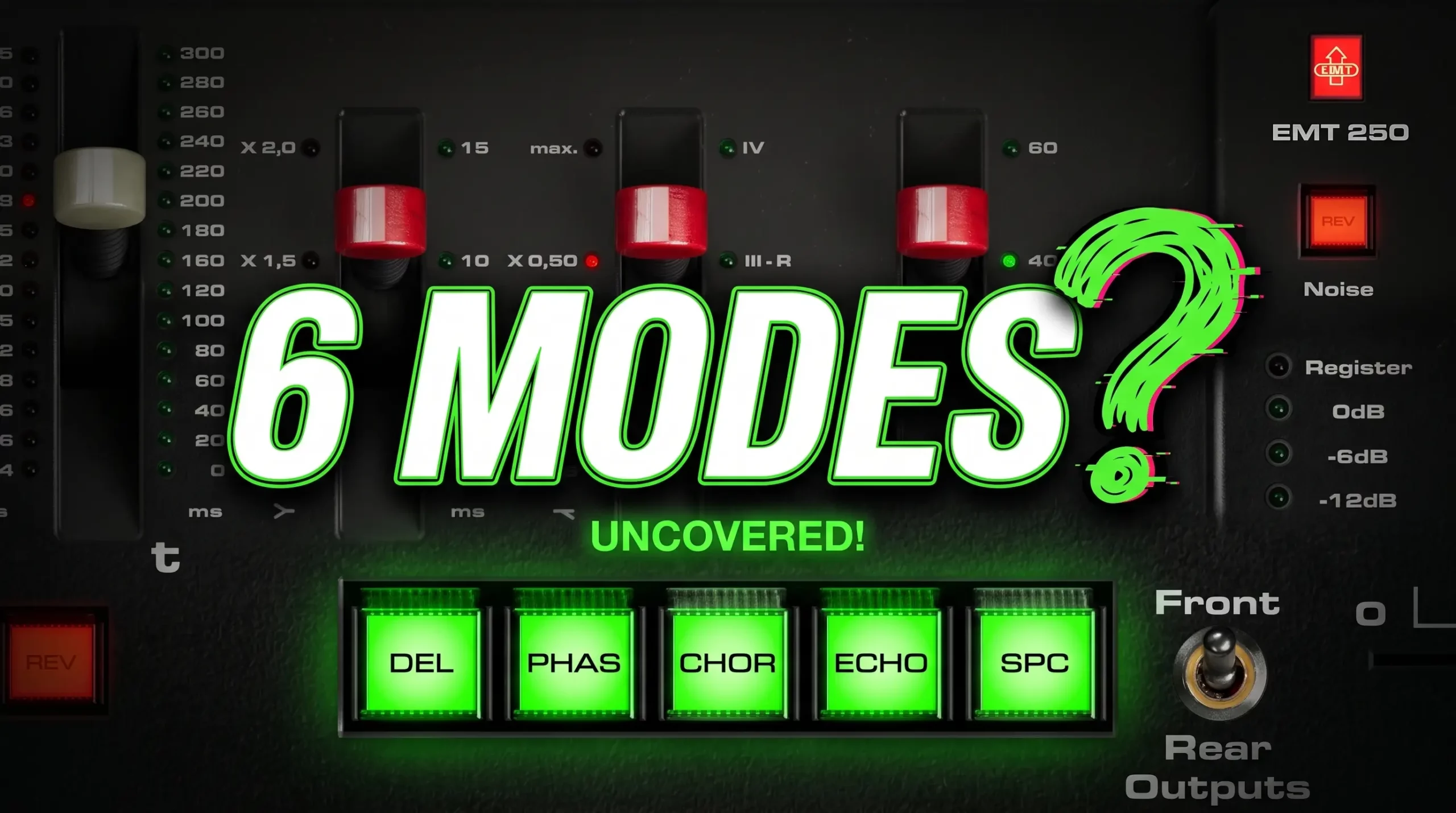
The UAD EMT 250 has an unusual control layout. The same four levers remain visible as you switch between modes, but their functions can change depending on which effect is selected.
That means a lever controlling reverb decay in one mode might control delay time or another parameter in a different mode.
This guide explains what each lever does in Reverb, Delay, Phase, Chorus, Echo, and Space modes and includes a quick reference chart you can use while working with the plugin.
In the video below, I take a quick look at how the EMT 250 works and demonstrate the different modes.
Related Post: Vocal Magic or Marketing Hype? The Truth About UAD’s Topline Suite Plugin!
The UAD EMT 250 Control Layout
The EMT 250 has four main levers. Depending on the mode you select, the first three levers can perform completely different functions.
The fourth lever remains dedicated to predelay, measured in milliseconds.
Here is a quick reference chart:
| Mode | Lever 1 | Lever 2 | Lever 3 | Lever 4 | Front/Rear |
|---|---|---|---|---|---|
| Reverb | Reverb Decay | LF Decay | HF Decay | Predelay | Output pair |
| Delay | Coarse Time | Fine Time | Select L/R | Predelay | Stereo/Mono |
| Phase | Phase | — | — | Predelay | Output pair |
| Chorus | — | — | Variation | Predelay | Stereo/Mono |
| Echo | Coarse Time | Fine Time | HF Damping | Predelay | Input Mute |
| Space | — | — | — | Predelay | Output pair |
Once you understand this layout, the EMT 250 becomes much easier to navigate.
Reverb Mode
Let’s start with the mode most people probably associate with the EMT 250: Reverb.
In Reverb mode, Lever 1 controls the main Reverb Decay. This determines how long the reverb lasts.
Lever 2 controls LF Decay, which affects how the low-frequency content of the reverb fades away.
Lever 3 controls HF Decay, affecting how long the higher-frequency content remains in the reverb tail.
This gives you some useful control over the character of the reverb. Instead of only adjusting the overall length, you can also influence how the low and high frequencies decay.
Lever 4 controls Predelay, measured in milliseconds.
Predelay creates a short amount of time between the original sound and the beginning of the effect. On a vocal, for example, adding some predelay can help create separation between the dry vocal and the reverb.
The plugin also includes a Dry/Wet control and an option to make the output always wet, which can be useful when using the EMT 250 on an effects bus or send.
Six Different Modes
The EMT 250 includes six main modes:
- Reverb
- Delay
- Phase
- Chorus
- Echo
- Space
The interesting part is what happens when you switch between them.
The interface itself doesn’t dramatically change, but the functions assigned to the levers do.
That means the EMT 250 is not simply a reverb plugin with a few additional presets. It is a collection of different effects built around the same hardware-inspired interface.
Delay Mode
In Delay mode, the controls shift away from reverb parameters.
Lever 1 controls Coarse Time, while Lever 2 controls Fine Time.
Lever 3 is used to select or work with the left and right sides of the delay.
This makes the Delay mode useful for creating different timing relationships and stereo effects.
Echo Mode
Echo mode also uses the first two levers for timing.
However, Lever 3 becomes HF Damping.
This affects how the higher frequencies behave in the echo repeats. Increasing the damping can make the repeats become darker as they continue.
That gives Echo mode a different purpose from the standard Delay mode, even though both are based around repeated signals.
Phase Mode
Phase mode simplifies the available controls.
Lever 1 controls the Phase effect, while the other two effect controls are inactive.
As with the other modes, Lever 4 remains the predelay control.
Chorus Mode
In Chorus mode, Lever 3 controls Variation.
The other main effect levers are inactive, making this one of the simpler modes to understand.
The chorus can be useful for adding movement and width to sounds without changing to an entirely different plugin.
Space Mode
Space mode has the simplest control layout of the group.
The main effect levers are inactive, leaving predelay as the primary adjustable lever.
Like the other modes, it provides another distinct character within the EMT 250 interface.
Front and Rear Controls
The Front/Rear control also changes its function depending on which mode is selected.
In some modes, it relates to different output pairs.
In Delay and Chorus modes, it changes the output behavior between stereo and mono.
In Echo mode, it functions as an input mute, allowing existing echoes to continue while preventing additional input from entering the effect.
Once again, this is part of what makes the EMT 250 unusual: the controls are not fixed. Their functions depend on the mode.
Is the UAD EMT 250 Just a Reverb?
Not really.
The reverb is obviously a major part of the EMT 250, and the separate controls for overall decay, low-frequency decay, and high-frequency decay provide useful ways to shape its sound.
But the additional Delay, Echo, Phase, Chorus, and Space modes make the plugin more than a straightforward vintage reverb recreation.
The main thing to understand is the control layout.
When you switch modes, the first three levers can change their jobs. Lever 4 remains predelay.
Once you get used to that concept, the unusual-looking EMT 250 interface starts to make much more sense.
If you’re interested in hearing the different modes in action, check out the video above, where I demonstrate the UAD EMT 250 using a vocal track from one of my own songs.
UAD EMT 250: EMT® 250 Classic Electronic Reverb
LINKS
- Turn Your Passion into Profits
- SoundGym 20% discount coupon
- Deals on Plugin Boutique
- Save Big on Waves Plugins
- Native Instruments LIMITED TIME
The links to iZotope, Plugin Boutique, Mastering The Mix, SoundGym, Native Instruments, iZotope, and Waves are affiliate links, meaning I may earn a small commission if you purchase through them. This helps support the Blog and My YouTube channel at no extra cost to you. I only recommend products I personally use or believe bring real value to producers and songwriters.


Leave a Reply