
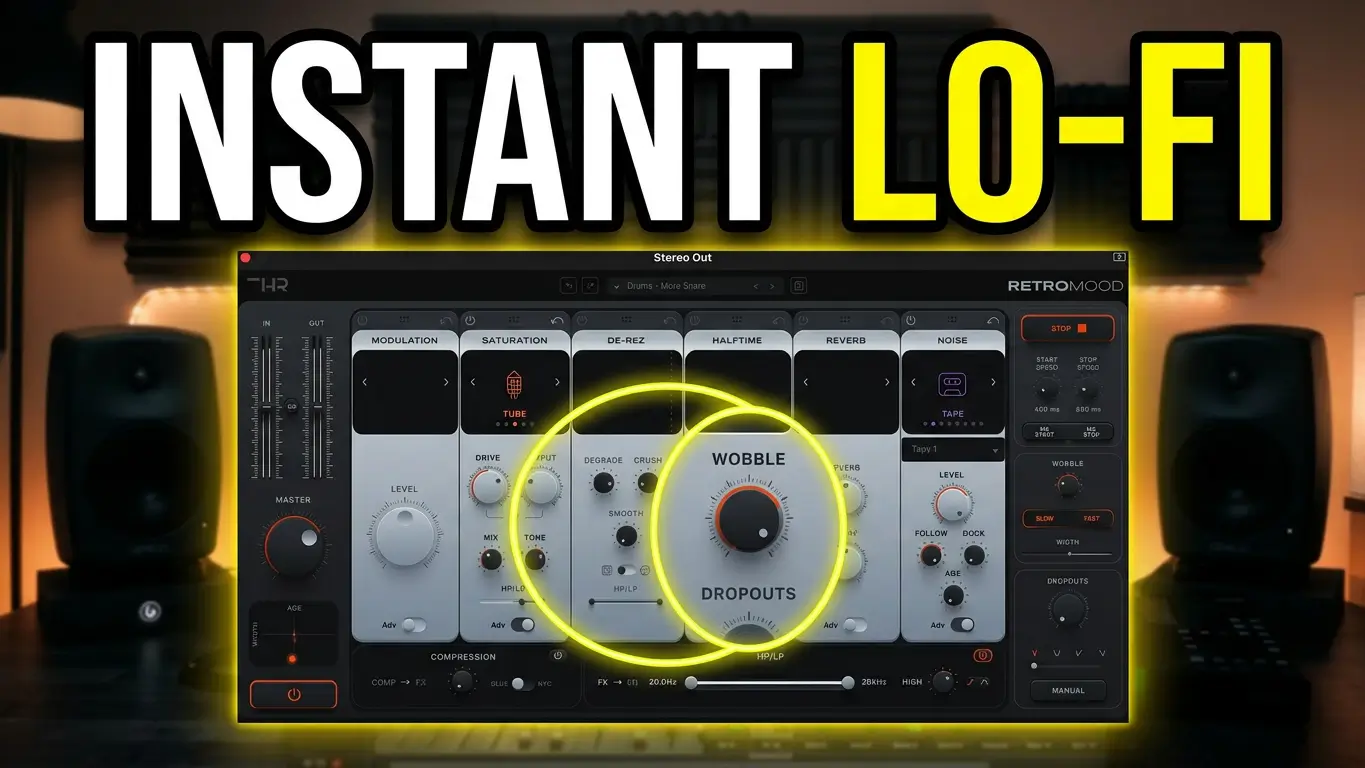
If you’re looking for a way to add lo-fi textures, vintage character, movement, and creative audio degradation to your music, THR RetroMood is a plugin worth exploring. It combines modulation, saturation, bit crushing, halftime effects, reverb, and noise generation in one sound-design tool, with additional features for tape stops, wobble, dropouts, and stereo processing.
Watch the THR RetroMood Plugin Overview
In this video, I take a closer look at THR RetroMood and demonstrate its different effects on a drum track and piano. Rather than focusing on just one sound, I explore the various modules, their controls, and how combining them can create anything from subtle vintage warmth to heavily degraded, experimental textures.
What Is THR RetroMood?
THR RetroMood is a creative audio effects plugin designed to change the character of sounds in a music production. It brings several types of processing together, making it possible to add movement, distortion, degradation, ambience, and background noise without relying on a collection of separate plugins.
The interface is organized around six main modules: Modulation, Saturation, RESZ, Halftime, Reverb, and Noise. Each module has its own set of controls, and the ability to rearrange the modules adds flexibility to the sound-design process.
The plugin can be used on drums, piano, instruments, and other audio sources. The goal isn’t necessarily to make everything sound old or lo-fi. Sometimes a little movement, saturation, or background texture is enough to make a track more interesting.
Modulation, Tape Stops, and Wobble
The modulation section offers ways to introduce pitch instability and movement inspired by turntables, reel-to-reel tape, and cassette recordings. Controls let you adjust the intensity of these effects, from subtle fluctuations to more obvious changes in character.
RetroMood also includes tape-stop effects, adjustable stop speeds, wobble, and dropouts. These features can be useful for transitions, rhythmic interruptions, and creative effects that make a sound feel less static.
Additional processing includes high-pass and low-pass filters, compression, stereo width, and aging controls. The New York-style parallel compression option provides another way to shape the dynamics and presence of a track.
Saturation and Audio Degradation
The Saturation module includes tape, soft clipper, tube, fuzz, and diode-style processing. Mix, tone, and filtering controls help determine how much character or distortion is added to the original sound.
The RESZ module focuses on degradation and crushing effects. It can reduce the clarity of a sound, introduce lo-fi characteristics, and create more aggressive textures. Different degradation styles and smoothing controls help tailor the result, while high-pass and low-pass filters provide additional control over the processed signal.
These tools can be useful when a pristine digital sound feels too clean for the arrangement. They also offer creative options for building unusual textures and contrasting clean and processed elements.
Halftime Effects and Reverb
The Halftime module adds rhythmic processing, with reverse and forward playback options and mix controls for blending the effect into the original signal. This can create different rhythmic feels without requiring the entire track to be processed in the same way.
RetroMood’s reverb section includes spring, room, hall, chamber, and plate options. Convolutional reverb, decay controls, stereo width, ducking, and filtering provide additional ways to shape the ambience.
The combination of halftime processing and reverb can be particularly useful for creating atmospheric passages, dramatic transitions, and unusual instrumental textures.
Vinyl Noise, Tape Hiss, and Vintage Atmosphere
The Noise module includes textures inspired by vinyl records, tape, VHS, gramophones, radios, film projectors, and weather. Multiple variations are available for the different noise types, and the level can be adjusted to blend the texture into a track.
The advanced controls include options for pattern-following behavior, aging, and ducking. Noise can be used subtly in the background or made more prominent as part of the sound itself.
As with most lo-fi processing, restraint matters. A small amount of noise or instability can add character, while too much can distract from the music.
Is THR RetroMood Worth Exploring?
THR RetroMood brings several creative effects into one interface, offering a practical way to experiment with vintage-style processing, lo-fi sound design, and more extreme audio manipulation.
What makes the plugin interesting is the ability to combine its modules rather than treating each effect as an isolated tool. Modulation, saturation, degradation, reverb, and noise can work together to transform an ordinary drum loop or piano part into something with a distinctive character.
In my demonstration, I explore the main features and experiment with different combinations. The best results will depend on the source material and the sound you’re trying to create, so experimenting with individual modules before blending them together is a good place to start.
If you’re interested in creative effects that go beyond conventional mixing and can help you develop unusual textures, THR RetroMood is worth a closer look.
THR RetroMood (affiliate link)

Leave a Reply