
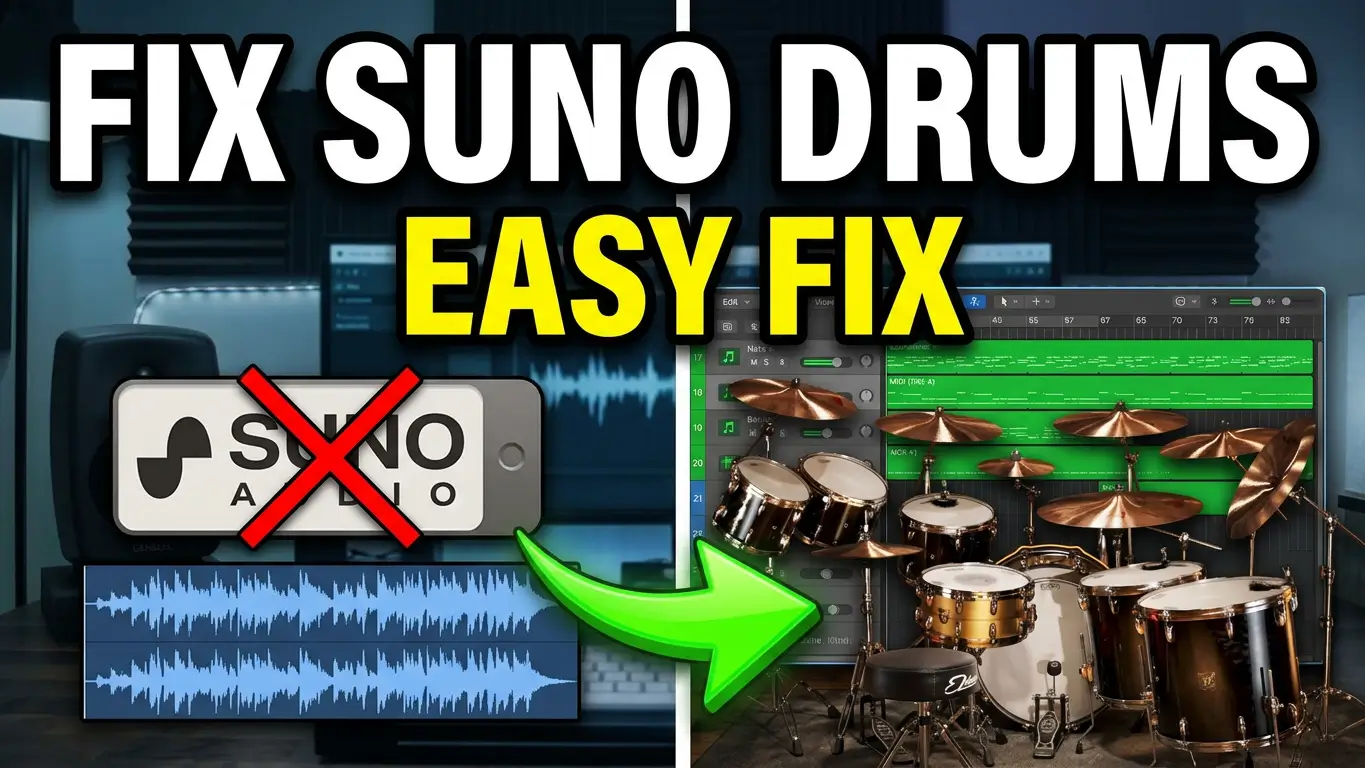
What do you do when an AI-generated song has a good overall idea, but one of the most important parts of the production just doesn’t sound right? In this case, the drums from a Suno-generated song were the problem, so I decided to replace them rather than simply accept the original stems.
I downloaded the stems from Suno and started working with them in Logic. The drums sounded particularly rough, so the first step was figuring out how to separate the individual drum elements and turn the existing performance into something I could actually edit.
Isolating the Suno Drums
I used Remix Drums to isolate the different elements of the drum performance, including the kick, snare, hi-hats, cymbals, and other percussion.
Once I had the individual elements isolated, I bounced them into Logic. This gave me audio tracks that I could use with Logic’s drum replacement tools.
Logic can analyze an audio drum performance and create MIDI from it. That meant I could preserve the basic performance from the original Suno track while replacing the sounds themselves.
Why I Didn’t Use Suno’s MIDI
Suno also provided MIDI drum tracks with the downloaded stems, but they didn’t line up correctly with the audio in this particular song.
Rather than trying to force the existing MIDI to work, I decided to create new MIDI directly from the drum audio.
This turned out to be a much more useful approach because I could take the actual drum performance I was hearing and use it to trigger completely different drum sounds.
Trying Different Drum Sounds
Once the MIDI was created, I could experiment with different drum instruments without changing the basic performance.
I started with EZ Drummer, and I also tried Addictive Drums to hear how different kits changed the character of the song.
This is one of the useful things about converting an audio performance into MIDI. The original drum sounds don’t have to determine the final production.
You can change the kit, adjust individual drums, replace sounds, and continue producing the song just as you would with a traditionally recorded performance.
Rebuilding More Than the Drums
After the initial recording, I went back and did considerably more work on the production.
I replaced the bass and used a Logic bass with MIDI. I also fixed the cymbals and toms and moved the replacement drums onto EZ Drummer.
I added a free Analog Obsession plugin to work on some of the high-end content, and I also experimented with guitar replacement.
The original AI vocals remained in the arrangement.
That left me with something more interesting than simply using the original Suno stems. The song became a hybrid production: the original AI-generated performance provided some of the source material, while the drums, bass, guitars, and processing could be rebuilt and shaped inside Logic.
The Finished Result
The goal wasn’t to completely recreate the song from scratch. It was to take something that wasn’t working and find a practical way to improve it.
The original Suno drums weren’t usable for the production I wanted, but the underlying performance contained enough information to extract and convert into MIDI.
That opened up a completely different production workflow.
Instead of treating the AI-generated stems as the final product, I could treat them as source material and continue producing the song in a traditional DAW.
That’s the approach I explore in the video above.
The song also appears in different versions on Songs by Greg, where I’m continuing to document the songwriting and production process behind these songs.


Leave a Reply