
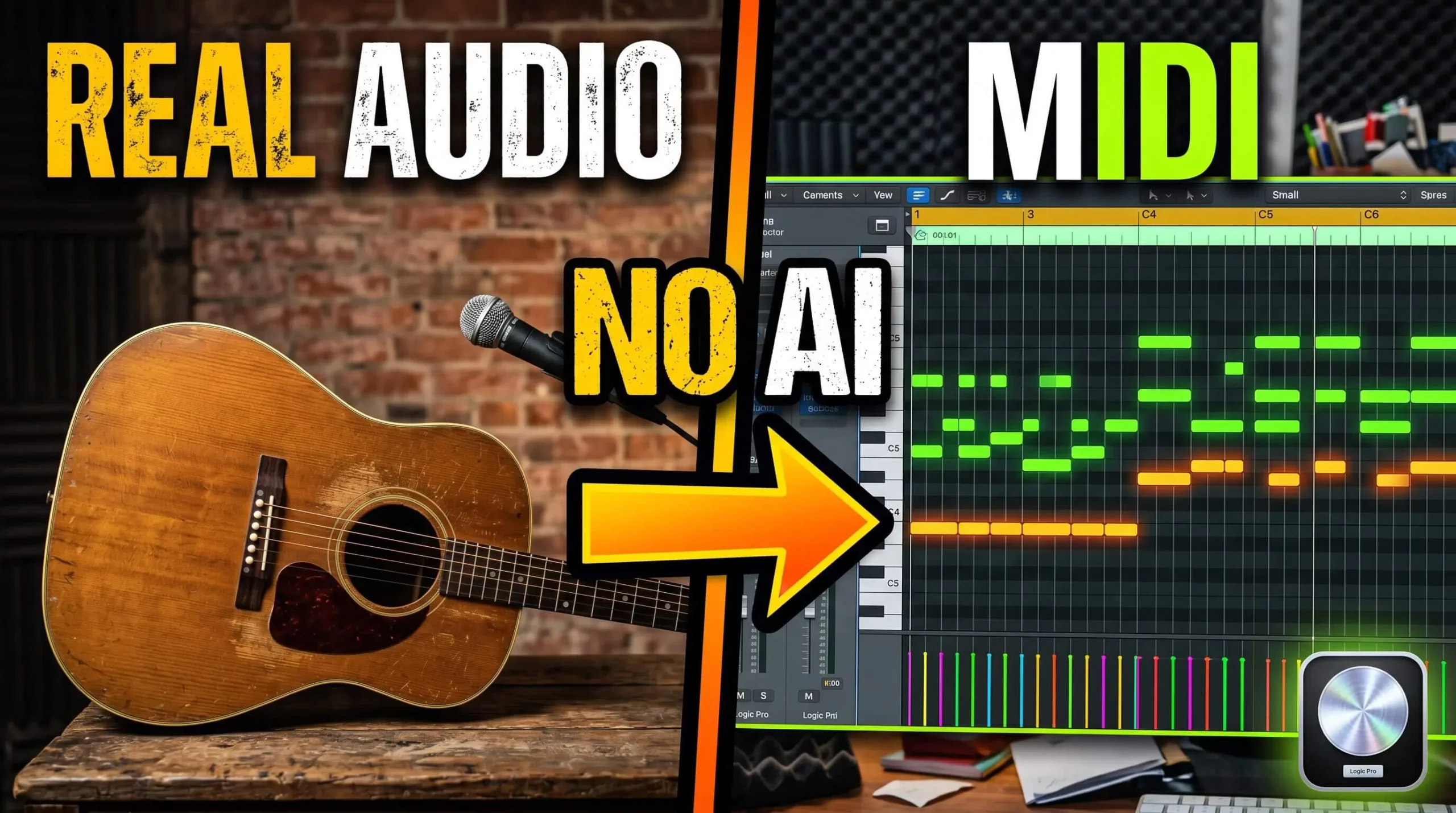
If you’ve ever tried converting guitar audio into MIDI before, you probably know the experience can be frustrating. Missed notes, strange timing, glitchy tracking, robotic results — for a long time, guitar-to-MIDI workflows felt more like a tech demo than something you’d actually use in a real music production session.
But things are getting interesting.
In this video, I take a look at the Prism Audio-to-MIDI plugin and test how well it can turn a real acoustic guitar recording into usable MIDI inside Logic Pro — without using AI.
And honestly, the results were surprisingly good.
Related Posts:
ReSing Max Review: This Plugin Replaces Your Singer… And It Actually Works
Sonic Atlas Quick Look: Unleashing Global Grooves in Your DAW
Turning Guitar Audio Into MIDI Without AI
One of the most interesting things about Prism is that it keeps the original feel of your performance intact. This is not an AI-generated replacement or some random approximation of what you played.
It’s still your timing.
Still your dynamics.
Still your riff.
Still your mistakes.
The plugin simply converts your recorded audio into MIDI data that you can use with virtual instruments, synths, bass sounds, guitars, and more.
That means if your guitar playing has groove, swing, velocity changes, or natural imperfections, those details can carry over into the MIDI performance.
For songwriters and producers, that opens up a lot of creative possibilities.
The Workflow Inside Logic Pro
For this demo, I recorded a simple acoustic guitar part directly into Logic Pro using a microphone and a basic drum groove as a timing reference.
From there, Prism captures the audio and generates MIDI data based on the performance.
The process is pretty straightforward:
- Record your guitar part
- Insert Prism on the audio track
- Capture the performance
- Generate MIDI
- Drag the MIDI into instrument tracks
- Start experimenting
I kept quantization turned off during the demo because I wanted to preserve the human feel of the original guitar performance.
That ended up being one of the coolest parts of the entire process.
Instead of sounding stiff or robotic, the converted MIDI still felt musical and natural.
From Acoustic Guitar to Full Production
Once the MIDI was generated, I started layering different instruments over the performance.
First, I used the MIDI data to trigger an electric guitar sound. Then I duplicated the MIDI and created a bass part from the same performance.
Even with a simple riff, things started sounding much bigger very quickly.
This is where audio-to-MIDI workflows become incredibly useful for music production:
- Build arrangements faster
- Experiment with instrument layering
- Turn riffs into synth parts
- Create basslines from guitar performances
- Slice, edit, and rearrange MIDI sections
- Generate entirely new song ideas from one recording
And because the performance originated from real playing, everything still feels more human compared to drawing MIDI notes manually.
Why “No AI” Is Actually Interesting Here
A lot of modern music tools are heavily focused on AI right now, but Prism takes a different approach.
Instead of generating ideas for you, it focuses on translating your actual performance into editable MIDI data.
That distinction matters.
For musicians who still want their own playing style, timing, and expression to remain part of the creative process, this workflow feels much more personal and musical.
It’s less about replacing creativity and more about expanding what you can do with a recorded performance.
Watch the Full Video
In the full video, I walk through:
- Recording the acoustic guitar
- Capturing audio with Prism
- Generating MIDI in Logic Pro
- Creating guitar and bass parts
- Preserving human timing and velocity
- Building a fuller arrangement from one simple recording
If you’re interested in guitar-to-MIDI workflows, audio-to-MIDI plugins, songwriting tools, or creative music production techniques, this demo is definitely worth checking out.
Final Thoughts
Prism ended up being much more usable than I expected for turning recorded guitar into MIDI.
Is it perfect? No. You’ll still want to clean up notes occasionally, especially for bass parts or more complicated performances. But for songwriting, experimentation, layering instruments, and quickly building ideas, it’s a genuinely creative tool.
And the fact that it works without relying on AI makes it even more interesting right now.
If you’ve used guitar-to-MIDI tools before, I’d be curious to hear your experience. Some older systems were notoriously rough, but workflows like this feel much closer to something producers and songwriters could realistically use every day.

Leave a Reply